Laguna Beach

City Market · City Intelligence Published · Orange County, California

Laguna Beach is not a conventional tract market. Value here is unusually property specific, and two homes a few streets apart can belong to completely different competitive sets. The neighborhood name tells you where to start. View class, topography, lot usability, parking, beach-access mechanics, housing product, entitlement history, coastal jurisdiction and private rights tell you what the property actually is.

An eight-module guided path through the Laguna Beach research, for agents learning the market rather than looking something up.

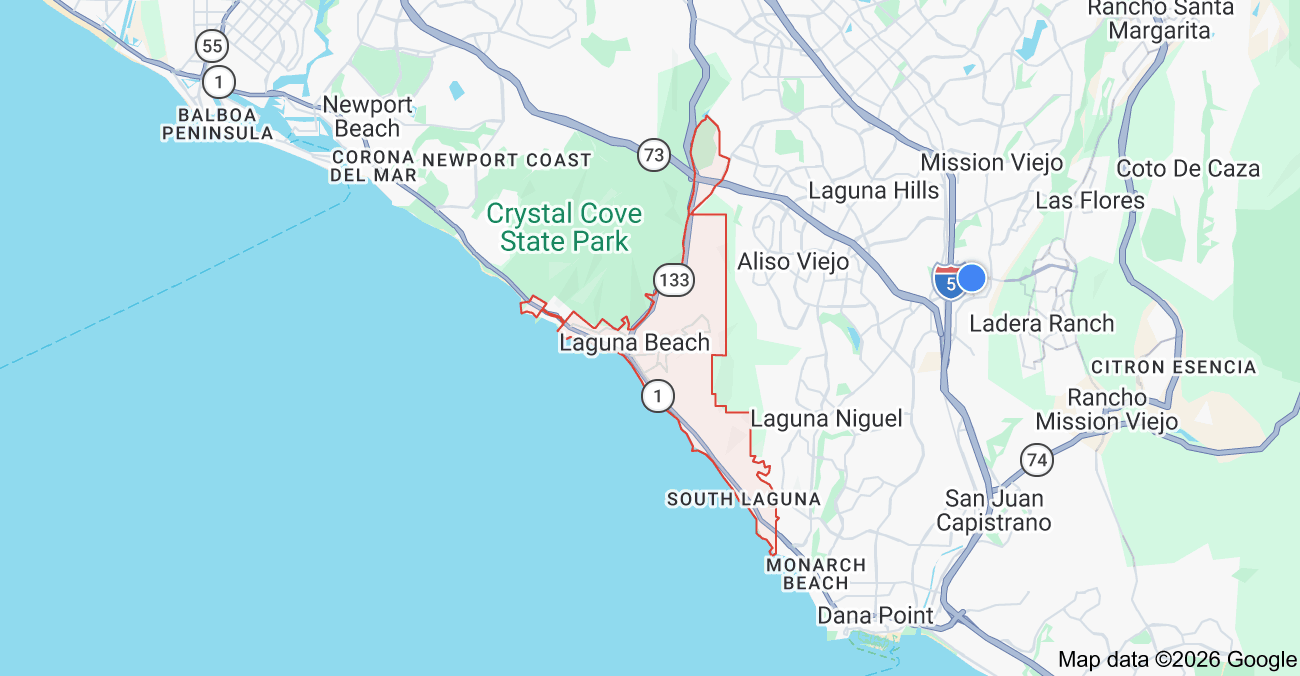
Orientation map showing Laguna Beach within South Orange County, California
Laguna Beach orientation map. For geographic orientation only. Do not rely on this image as an official municipal, market, subdivision, parcel or association boundary.

Open in Visual AtlasCompare This MarketClient Prep

Durable research last reviewed September 4, 2026

Market Brief

Laguna Beach in Brief

Market Identity

Laguna Beach is not a conventional South Orange County tract market. It is a highly site-specific coastal market shaped by topography, ocean orientation, incremental custom development, older housing, private coastal enclaves, hillside access, coastal regulation and a century of lot-by-lot rebuilding. A neighborhood name is only the first layer. Two nearby properties can appeal to different buyers because one offers a flat entry, usable yard, protected-feeling view corridor and easy beach access while the other offers more square footage but requires several flights of stairs, sits on a narrow road, has limited parking or carries more complicated development constraints.

Housing Snapshot

Housing ranges from early cottages and revival-era homes to postwar ranches, vertical hillside houses, attached oceanfront developments, gated coastal enclaves and contemporary custom estates. Production housing exists, but it is the exception rather than the organizing rule for most of the city. Top of the World matters because its flatter lots and tract-oriented single-story housing differ sharply from much of Laguna Beach.

Common Alternatives

  • Corona del Mar
  • Newport Coast
  • Dana Point and Monarch Beach
  • San Clemente
  • Selected Laguna Niguel luxury markets

Key Value Drivers

  • Exact site and view quality. View type, orientation, elevation, foreground and vulnerability matter more than a generic ocean view label.
  • Lot usability and daily access. Flatness, stairs, driveway grade, parking, garage access and usable outdoor space change the buyer pool.
  • Coastal position and access. Ocean side versus inland side, walkability, the actual route to the sand, bluff stairs, Coast Highway crossings and village proximity can matter as much as straight-line distance.

Important Watchouts

  • Do not assume development potential. Zoning capacity is not an approved buildable envelope. Design Review, coastal permitting, specific plans, neighboring view and privacy concerns and existing conditions all matter.
  • Hazards are property specific. Fire severity, geotechnical conditions, drainage, bluff exposure and insurance need address-level review.
  • Legal configuration matters. Older and custom homes can carry complicated permit histories, nonconforming conditions or gaps between physical use and approved records.

Structured intelligence last reviewed September 4, 2026. HOA dues, taxes, assessments, school assignment, insurance, fire classification, Coastal Development Permit jurisdiction, permitted square footage, historic status, short-term lodging rights and development potential must be verified for the specific property.

Quick Intelligence

Laguna Beach Market Intelligence

A structured summary of the durable research below. The lens narrows this summary only. The full research sections on this page are always available.

Value Drivers

The neighborhood name is only the first layer

Laguna Beach values are unusually property specific. Neighborhood identity matters, but view class, topography, parking, stairs, lot usability, beach access, architecture and entitlement history can separate nearby homes into completely different competitive sets.

Go deeper

An ocean view needs a classification

Buyer

Ocean view is too broad to price intelligently. A buyer may value breaking whitewater, a cove or coastline view, open ocean, Catalina sunsets, high-elevation horizon water or a filtered corridor very differently. The foreground and the possibility of future obstruction also matter.

Go deeper

Buyer Fit

Flatness, parking and stairs can matter as much as size

Buyer

A 3,000-square-foot Laguna Beach house can function very differently depending on how the property meets the street. A flat driveway, usable two-car garage, level primary living and real yard space are scarce enough in parts of the city that they can matter more than additional interior square footage.

Go deeper

Tradeoffs

Beach proximity is not the same as beach access

Buyer

A home can sit close to the ocean and still require a steep public stairway, a Coast Highway crossing or a drive. During a showing the useful question is not how close the beach is. It is what the actual route from this front door to the sand looks like.

Go deeper

Watchouts

Development rights need parcel-level verification

Laguna Beach is a poor market for casual assumptions about second stories, additions, major remodels or rebuilds. The property file, zoning, Design Review criteria, applicable specific plan, coastal jurisdiction and neighboring context all need to be understood before a buyer pays for potential.

Go deeper

Fire, slope and insurance are property questions

Agent Study

The City's current fire maps include Moderate, High and Very High zones, and geological conditions vary dramatically. Do not generalize the entire city or a whole neighborhood. Use the current address-level maps, property records and the appropriate specialists.

Go deeper

Competitive Set

The nearest sale may not be the best comp

Seller

A sale down the street can be a worse comparable than one farther away if the two properties have different view classes, lot usability, access, housing product or coastal position. Comp selection here should begin with the property system, then refine by geography.

Go deeper

Agent Talking Points

Emerald Bay belongs in the market, but not in the City

Agent Study

Emerald Bay uses a Laguna Beach postal identity and competes directly inside the Laguna Beach coastal market, but it is legally unincorporated Orange County. Market taxonomy and legal geography need to stay separate.

Go deeper

Key Questions

  1. 01

    What kind of view is the buyer actually paying for?

    Classify the view, evaluate the foreground, identify potential vegetation or structural change, and understand what is visible from the primary living areas rather than from a marketing photograph.

    Go deeper
  2. 02

    How does the home meet the street?

    Count stairs, inspect driveway grade, test garage usability, look at guest parking, understand street width, and see whether the primary living area sits above or below street level.

    Go deeper
  3. 03

    What does this property actually compete against?

    Start with product, view, lot, access and buyer profile, then use geography. Do not build the competitive set from radius alone.

    Go deeper
  4. 04

    What approvals or constraints already exist in the property file?

    Pull the City record, permit history, discretionary approvals, conditions of approval and available property disclosures before describing remodel potential or legal configuration.

    Go deeper
  5. 05

    Which coastal-permitting path applies to this parcel and project?

    Most of Laguna Beach operates under the City's certified Local Coastal Program, but retained Coastal Commission jurisdiction remains in specific areas. Hobo Canyon needs extra attention because current City and Coastal Commission descriptions are not perfectly aligned.

    Go deeper
  6. 06

    What needs to be verified before contingencies are removed?

    At minimum consider insurance, fire-zone status, permits, legal square footage, geology and drainage where relevant, HOA and private rights, taxes and assessments, school assignment, coastal jurisdiction, view conditions and the actual beach-access route.

    Go deeper

Laguna Beach at a Glance

Incorporated 1927
A small coastal city with a long art-colony history and a development pattern built lot by lot rather than tract by tract.
13 canonical areas
The City's own planning geography, from Downtown and North Laguna to South Laguna and Sycamore Hills.
Certified LCP since January 13, 1993
Most coastal permitting runs through the City, with specific areas still handled by the Coastal Commission.
Four LBUSD schools
El Morro Elementary, Top of the World Elementary, Thurston Middle and Laguna Beach High School.
Annexed South Laguna in 1987
South Laguna was unincorporated until December 31, 1987, which still shows up in records and identity.
Property specific pricing
Two homes on the same street can sit in different competitive sets because of view, access and lot usability.

The Geography Explains the Market

Ocean side and inland side

Orientation

Coast Highway divides more than traffic. Ocean side, inland side, bluff, terrace and hillside positions produce different views, access patterns and buyer pools.

Terraces, canyons and ridges

Topography

North Laguna sits on a comparatively usable coastal terrace. Bluebird Canyon, Laguna Canyon and Aliso Canyon run inland. Mystic Hills, Temple Hills, Arch Beach Heights and Top of the World climb.

Elevation changes everything

Elevation

Elevation determines view breadth, stair counts, driveway grade, garage usability and how the house is entered. It is a housing variable, not scenery.

The village core

Walkability

Downtown and the central coastal blocks are the most walkable part of the market, with the tradeoffs that come with visitor activity and parking pressure.

Coastal Zone coverage varies

Regulation

Most of the city sits in the Coastal Zone. City coastal-permit guidance identifies the Sycamore Hills area, east of Laguna Canyon Road and north of El Toro Road, as outside it.

The map is orientation only

Caution

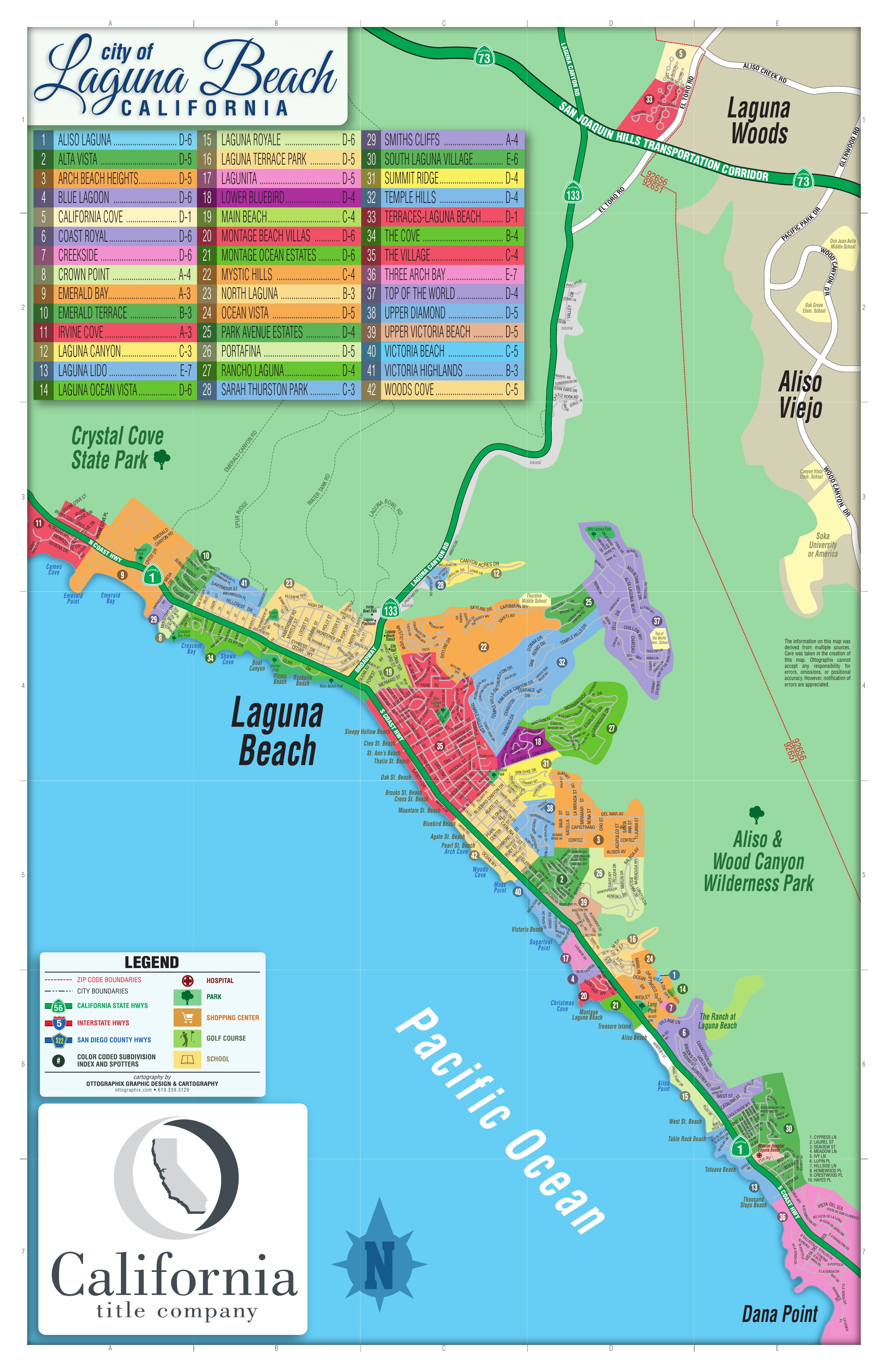
The subdivision map shows 42 labels. Those labels are not 42 equal communities. Some are landmarks, aliases, condominium projects or research scaffolding.

Laguna Beach Subdivision Map

Color-coded subdivision map of Laguna Beach showing named neighborhoods and communities

Pinch, scroll or use the controls to zoom. Drag to pan.

Laguna Beach subdivision map. Labels vary in kind and are not 42 equal communities.

Use this map for orientation only. Labels vary in kind: some are canonical City areas, some are private communities, some are condominium developments, one is a landmark and one is simply another name for Downtown. Boundaries, jurisdiction and hierarchy for a specific property are confirmed through City records and title.

How to Read the Laguna Beach Market

Start with the neighborhood

Step 1

Identify the canonical area. It tells you the general character, the topography and the likely product mix, and nothing more.

Identify the property system

Step 2

Detached hillside, coastal terrace, village walkable, canyon, attached oceanfront, gated enclave or ridge tract. This is the real competitive set.

Classify the view

Step 3

Whitewater, cove, open ocean, high-elevation horizon, ocean and canyon, or filtered. Note orientation, foreground and vulnerability.

Evaluate the site

Step 4

Slope, stairs, driveway grade, garage usability, guest parking, street width, usable outdoor space and how the home meets the street.

Walk the beach route

Step 5

Proximity is not access. Walk the actual path, including stairs, crossings and gates.

Read the housing product

Step 6

Cottage, revival era, postwar ranch, vertical hillside, attached oceanfront or contemporary custom. Condition and generation matter.

Pull the City record

Step 7

Permit history, discretionary approvals, conditions of approval, nonconforming conditions and disclosures before anyone talks about potential.

Verify the regulated layers

Step 8

Coastal jurisdiction, specific plan, Design Review, fire zone, geology, historic status, short-term lodging permits, HOA and private rights.

The Canonical City Hierarchy

Thirteen areas make up the canonical City hierarchy. Several corrections matter for agents: Victoria Beach belongs to Central Laguna, not South Laguna. Lower Bluebird belongs to the Central Laguna and Woods Cove system, not to upland Bluebird Canyon. Hillside and Ridgelines is an analytical grouping, not a parent area. Laguna Village and The Village are aliases for Downtown. Smithcliffs is the canonical spelling, with Smiths Cliffs kept as an alias.

Downtown

Civic and commercial core, the most walkable housing in the city. Laguna Village, The Village and Main Beach are aliases or landmarks here, not separate parents.

North Laguna

Coastal terrace, coves, bluff property and several private enclaves including Irvine Cove and Smithcliffs.

Central Laguna

Woods Cove, Lower Bluebird, Rockledge, Upper Victoria, Alta Vista and Victoria Beach. Victoria Beach is Central Laguna.

Laguna Canyon

The SR-133 corridor with Canyon Acres, Castle Rock and Sun Valley. A different environment from the coast.

Mystic Hills

Hillside neighborhood above Downtown, including Manzanita, with a rebuilding history after the 1993 fire.

Temple Hills

Established hillside market above the Village, including Rimrock.

Bluebird Canyon

Upland canyon and hillside detached homes including Rancho Laguna. Separate from Lower Bluebird.

Diamond / Crestview

Hillside custom and remodeled housing with its own Specific Plan. Upper Diamond is a child identity.

Arch Beach Heights

Vertical hillside living with narrow lots and its own Specific Plan.

Portafina

City-recognized hillside area of predominantly detached custom housing.

Top of the World

Ridge neighborhood with meaningful single-story tract-oriented housing on padded lots. Old Top of the World is a subarea.

South Laguna

Cardinal Way and Lagunita south to Three Arch Bay. Annexed December 31, 1987.

Sycamore Hills

Terraced residential tract development on steep hillside topography in the inland north of the city.

How Laguna Beach Got Built

  1. Early period

    Early cottages and the art colony

    Small coastal cottages and an art-colony identity established a pattern of individual, incremental building rather than large subdivisions.

  2. 1927

    Incorporation

    Laguna Beach incorporated in 1927 and continued to grow lot by lot along the coast and up the hillsides.

  3. Postwar

    Postwar hillside expansion

    Ranches, hillside houses and ridge neighborhoods including Top of the World brought a different product type to the city.

  4. 1987

    South Laguna annexation

    South Laguna was unincorporated territory until it was annexed effective December 31, 1987. Its separate identity persists.

  5. 1993

    Local Coastal Program certification

    The City's Local Coastal Program was certified January 13, 1993, moving most coastal permitting to the City.

  6. 1993 onward

    Fire and rebuilding

    The 1993 wildfire and the rebuilding cycle that followed shaped construction generations in Mystic Hills and nearby hillsides.

  7. Today

    Continuous rebuilding

    Remodels, rebuilds and infill continue lot by lot, which is why construction generation and permit history matter more here than a build-year column.

Private Communities and Named Enclaves

Gated coastal enclaves

Irvine Cove, Smithcliffs, Three Arch Bay, Lagunita and Blue Lagoon operate with private governance, private rights and their own access rules. Governing documents need to be read for the specific community.

Attached coastal product

Laguna Lido, Laguna Royale, Blue Lagoon and similar developments are condominium projects rather than neighborhoods. Unit counts, plans and association details still need verification.

Research scaffold labels

Montage Beach Villas and Ocean Estates appear on the map but remain research scaffolding rather than established market areas.

Aliases and landmarks

Main Beach is a landmark. The Village is an alias for Downtown. Upper Diamond is a child of Diamond and Crestview.

Hierarchy still to verify

California Cove, Terraces-Laguna Beach and Victoria Highlands are shown pending hierarchy verification rather than assigned by assumption.

Profiles to come

Emerald Bay, North Laguna, Irvine Cove, Three Arch Bay, South Laguna, Top of the World, Woods Cove and Lower Bluebird, Victoria Beach and Arch Beach Heights are planned Community profiles. They are not published as thin pages before the research supports them.

Emerald Bay: In the Market, Outside the City

Market

Market relationship

Emerald Bay competes directly inside the Laguna Beach coastal market. Buyers cross-shop it against North Laguna, Irvine Cove and other private coastal enclaves, and it carries a Laguna Beach postal identity.

Legal

Legal geography

Emerald Bay is unincorporated Orange County, not part of the incorporated City of Laguna Beach. County jurisdiction, special-district obligations and association governance are verified independently of City resources.

Treatment

How the platform treats it

Emerald Bay is carried as a Community under Laguna Beach for market purposes with its legal geography stated plainly. No dedicated page is published, and no City-based assumption about permitting, services or obligations should be applied to it.

Housing Product Across the City

Production housing exists in Laguna Beach, but it is the exception rather than the organizing rule. Most of the city was built and rebuilt one property at a time.

Early cottages

Small original coastal cottages, often on small lots, frequently remodeled or expanded over decades.

Revival-era homes

Period architecture with character value, and often the permit and configuration complexity that comes with age.

Postwar ranches

More conventional single-level housing, often on flatter or padded lots, common in ridge and inland areas.

Vertical hillside houses

Multi-level homes where living areas, garage and entry sit on different levels. Square footage alone does not describe how they live.

Attached oceanfront product

Condominium developments with ocean position and shared governance, competing against detached housing in a different way.

Gated enclave housing

Private communities with their own governance, access and architectural rules.

Contemporary custom estates

Rebuilt or new custom homes, usually the product of a specific entitlement path worth understanding.

Top of the World is different

Exception

Single-story tract-oriented housing on padded lots is materially different from most of the city and deserves separate study.

View Intelligence

Ocean view is too broad a term to price. Classify the view type, note the orientation, evaluate the foreground, consider whether vegetation or a future structure could change it, and see the view from the primary living areas. Where a Record of View exists for a property, it belongs in the diligence file. This platform does not publish percentage view premiums, because view value here is property specific.

Whitewater and breaking surf

Close-in ocean view with visible surf. A different experience and a different buyer than distant water.

Cove and coastline

Framed coves, points and coastline geometry rather than an open horizon.

Open ocean, Catalina and sunset

Wide water with island and sunset orientation. Direction matters as much as breadth.

High-elevation horizon

Broad panoramas from ridge and upper hillside positions, often with distance from the water.

Ocean and canyon

Mixed exposure where part of the view is inland. Often undervalued and often more private.

Filtered, corridor and peek

Partial water visibility through vegetation, structures or a narrow corridor. The most volatile category over time.

Lots, Access and Daily Usability

There is no universal uphill or downhill premium in Laguna Beach. What matters is how a specific property functions day to day.

  • Lot configuration

    Flat, downhill, uphill, street-to-street or bluff and oceanfront. Each changes how the house is built and lived in.

  • Stair count

    Count them from the street to the front door and between primary living levels.

  • Driveway grade

    Steep driveways affect parking, vehicles, guests and daily practicality.

  • Garage usability

    Whether a real vehicle fits, and how the garage relates to the entry and the kitchen.

  • Guest parking

    Street width, permit conditions and where visitors actually park.

  • Entry relationship

    Does the primary living area sit above or below the street, and how far from the car.

  • Usable yard

    Level outdoor space is comparatively scarce and is often the deciding factor for family buyers.

  • Decks versus ground-level space

    Deck square footage is not the same amenity as flat ground, and buyers value them differently.

Beach Access and Coastal Position

Proximity is not access. Before a buyer pays a premium for closeness to the ocean, walk the actual route from the front door to the sand and back.

Direct or private access

A private stair or association access point directly to sand. The strongest and rarest condition.

Gated community access

Access through private community infrastructure, governed by association rules and membership.

Flat walk

A level walk to a public beach entry, valuable and less common than buyers assume.

Bluff stairs

Public stairways with meaningful elevation change. Fine for some buyers and disqualifying for others.

Coast Highway crossing

The route crosses Coast Highway. It changes the daily experience regardless of straight-line distance.

Drive or climb

Reaching the sand requires a car or a significant climb back.

Construction, Condition and Generation

Generation matters more than year built

Many properties have been remodeled or rebuilt repeatedly. Identify the construction generation of what exists today.

Older systems

Plumbing, electrical, foundations, retaining structures and drainage on older hillside and coastal homes need real inspection.

Salt-air exposure

Corrosion, window and door condition, exterior materials and metal components are property inspection issues in exposed coastal positions.

Hillside structure

Caissons, retaining walls, decks and drainage systems carry maintenance obligations that flat-lot buyers may not anticipate.

Legal versus physical configuration

Basements, converted areas, decks and additions may not match approved records. Verify before describing square footage.

Historic character

Age alone does not create a presumption of historicity. Verify current status before implying restrictions or benefits.

Historic Status Is Verified, Not Assumed

Old is not historic

A large share of Laguna Beach housing is old. That does not by itself create historic designation or restrictions.

Check the current register

Verify whether the property appears on the City's current Historic Register and what that status entails today.

Recorded agreements

Look for recorded agreements or covenants tied to prior preservation incentives or approvals.

Property file and conditions

Project-specific requirements often live in the property file rather than in a general policy document.

Mills Act status

Verify whether an existing Mills Act contract applies. The City is not accepting new Mills Act applications during its current program review.

Fire, Geology and Physical Diligence

Current fire maps

The 2025 Local Responsibility Area Fire Hazard Severity Zone maps, released June 24, 2025, include Moderate, High and Very High zones within the city. Zone status is address specific and dynamic.

No citywide shorthand

This platform does not publish a single citywide fire percentage. Use the current maps for the specific address.

AB-38 diligence

For one-to-four unit residential transfers involving a Very High zone property, the AB-38 disclosure and defensible-space requirements are part of the transaction.

Geology and slope

Hillside and canyon properties vary widely. Geotechnical review, retaining structures and drainage deserve specialist attention where conditions warrant.

Bluebird Canyon history

Historic slope movement in the broader canyon is a reason for site-specific investigation, not a blanket statement about every parcel.

Insurance

Availability and pricing change. Have the buyer obtain current quotes early. No static premium figures or carrier lists are published here.

Property Records and Permit History

A practical workflow: start with MLS, walk the physical property, pull the City file, review permits and configuration, then verify planning, coastal, hazard and HOA layers. Never represent unverified living area as legal square footage.

City Clerk records

The City Clerk maintains records through its OnBase system, which is often the fastest path to older documents.

Real Property Disclosure requests

Community Development handles Real Property Disclosure requests, which surface the City's record for a property.

Permit history

Read what was permitted, when, and whether it was finaled. An unfinaled permit is a real issue.

Discretionary approvals

Variances, Design Review approvals and coastal permits often carry conditions that survive the original project.

Conditions of approval

These can restrict future work, require maintenance, or govern use in ways not visible on site.

Nonconforming conditions

Legal nonconforming status has consequences for remodeling, rebuilding and insurance conversations.

Planning, Coastal Review and Design Review

Zoning is not approval

A zoning envelope describes what might be considered. It does not describe what will be approved.

Design Review

Discretionary review considers neighborhood compatibility, privacy, view impacts and design. Outcomes are project specific.

No universal timeline

There is no standard entitlement timeline that applies to every project in Laguna Beach.

Specific plans

Downtown, the Laguna Canyon Annexation Area, Diamond-Crestview, Arch Beach Heights, Treasure Island and Three Arch Bay each carry specific plan context.

Neighbor context matters

View and privacy concerns from surrounding properties frequently shape what is achievable.

Buying potential is buying risk

If a buyer is paying for future development, the property file and a pre-purchase conversation with the City belong in the diligence period.

Which Coastal Permitting Path Applies

Primary path

City certified LCP

The City's Local Coastal Program was certified January 13, 1993. Most coastal development permits in the city are processed by the City under that certified program.

Exceptions

Areas the City lists as outside the certified LCP

City materials identify Blue Lagoon, Irvine Cove and Three Arch Bay as outside the certified Local Coastal Program, which affects the permitting path for projects there.

Verification flag

Hobo Canyon: open verification flag

Coastal Commission records continue to describe Hobo Canyon as a deferred-certification area. Current City and Commission descriptions are not perfectly aligned. This platform keeps the discrepancy visible rather than resolving it, and parcel-level jurisdiction should be confirmed with both agencies before relying on it.

Associations, Private Rights and Taxes

Many properties have no HOA

A large part of the city is ungoverned by an association. That is a feature for some buyers and a risk factor for others.

Gated communities

Private communities carry governance, architectural review, access control and their own maintenance obligations.

Attached developments

Condominium associations govern maintenance responsibility, reserves and rules that affect financing and cost.

Private roads

Some properties sit on private roads with shared maintenance responsibilities that need to be documented.

Beach-access rights

Private beach access is a property right defined by documents, not by proximity. Read the governing documents.

Verify the numbers

No dues, assessments or effective tax rates are published here. Obtain current dated figures and the actual tax bill for the specific property.

Short-Term Lodging Rules

No new permits in R-1, R-2 and R-3

New short-term lodging is not permitted in those residential zones.

Legal nonconforming uses

Existing permitted short-term lodging uses are legal nonconforming and run with the land rather than with the owner.

Operational rules

Updated operational requirements took effect July 1, 2025, with enforcement beginning October 1, 2025.

The City publishes a permit list

An approved-permit list is available. Verify the actual permit for the specific address rather than relying on a seller statement or a listing remark.

Schools

Laguna Beach Unified School District

The district serves the city with El Morro Elementary, Top of the World Elementary, Thurston Middle School and Laguna Beach High School.

Assignment is by address

Start with the address, use the district's current boundary resource, then verify with the district directly.

Never assign by neighborhood name

Neighborhood identity does not determine school assignment, and boundaries change.

Emerald Bay and unincorporated context

Verify assignment independently rather than assuming it follows the City boundary or the postal address.

Living in Laguna Beach

Walkability is real, and localized

Downtown and parts of the central coastal blocks are genuinely walkable. Much of the hillside city is not.

Beaches and coves

The coastline is a series of coves and beaches with different access, parking and character.

Trails and open space

Wilderness and ridge trail access is a meaningful amenity, especially from the upper hillside neighborhoods.

Arts and civic identity

The art-colony history is not marketing. It shapes events, downtown activity and seasonal patterns.

Visitor seasonality

Traffic, parking and downtown activity change by season. Show properties at different times of day and year when possible.

How the Market Is Structured

Property systems, not tracts

Detached hillside, coastal terrace, village walkable, canyon, attached oceanfront, gated enclave and ridge tract behave as separate submarkets.

Thin comparable sets

Because product varies so much, the useful comparable set is often small and rarely defined by radius.

Price per square foot is weak here

Citywide price per square foot mixes incompatible products. It is not a substitute for a real competitive analysis.

Views and access drive dispersion

Two homes of similar size can price far apart because of view class, access and lot usability.

Buyer Intelligence

Tradeoffs worth naming early

Most Laguna Beach decisions come down to a small set of tradeoffs. Naming them early saves months.

  • Walkability versus view breadth
  • Flat, usable lot versus panorama
  • Private rights and gated security versus flexibility
  • Ocean proximity versus actual beach access
  • Character housing versus predictable systems
  • Charm and location versus parking and stairs

Who tends not to fit

This is not a market failure, it is a fit question worth raising before touring.

  • Buyers needing abundant flat land
  • Buyers needing three or four car garages
  • Buyers wanting predictable tract floor plans
  • Buyers who need low-friction approvals
  • Buyers who want newer master-planned housing
  • Buyers unwilling to do property-level diligence

Buyer Diligence Checklist

Not every item applies to every property. Use this as a working list rather than a form to complete.

  • Coastal jurisdiction

    Confirm which permitting path applies to the parcel.

  • View classification

    Classify the view type and orientation.

  • Foreground

    Identify what sits between the house and the water.

  • Record of View

    Check whether one exists for the property.

  • Beach route

    Walk it, including stairs, gates and crossings.

  • Garage and driveway

    Test vehicle fit and driveway grade.

  • Stairs

    Count them from the street and between living levels.

  • City records

    Pull permits, approvals and disclosures.

  • Legal versus physical configuration

    Reconcile what exists with what is approved.

  • Design Review and specific plan

    Identify any applicable review path or plan area.

  • Fire hazard severity zone

    Check current address-level maps.

  • Insurance

    Obtain current quotes early.

  • Geology and drainage

    Investigate where slope or history warrants.

  • HOA and private rights

    Read governing documents where they apply.

  • School assignment

    Verify with the district by address.

  • Tax bill and assessments

    Review the actual bill rather than an estimate.

  • Short-term lodging permit

    Verify against the City's approved-permit list.

  • Historic status

    Confirm register status and any recorded agreements.

Seller Intelligence

The nearest sale is not automatically the best comp

A sale two doors down can be a poor comparable if the view class, lot usability or product differs.

Position by documented attributes

View classification, permitted improvements, approvals, access, parking and usable outdoor space are the arguments that hold up.

Prepare the record early

Permit history, approvals and disclosures gathered before listing prevent renegotiation later.

Do not lean on citywide averages

A citywide price per square foot figure invites the wrong comparison and weakens pricing conversations.

Show the property honestly

Stairs, parking and access will be discovered. Framing them early attracts the buyer who actually wants the property.

Comp Selection Framework

  1. 01

    Match the property system

    Detached hillside, coastal terrace, village walkable, canyon, attached oceanfront, gated enclave or ridge tract.

  2. 02

    Match the view class

    Whitewater, cove, open ocean, high-elevation horizon, ocean and canyon, or filtered.

  3. 03

    Match lot and access

    Slope, stairs, driveway, garage, parking and usable outdoor space.

  4. 04

    Match product and condition

    Construction generation, architecture, level of finish and legal configuration.

  5. 05

    Then refine by geography

    Geography narrows a valid set. It does not create one.

Competitive Sets

Inside Laguna Beach

Internal competition

Inside the city, the real contests are between distinct systems rather than between price bands.

  • North Laguna versus Central Laguna
  • Village and central coastal versus hillside
  • Top of the World versus steeper hillside neighborhoods
  • Gated enclaves versus open neighborhoods
  • South Laguna versus North and Central Laguna

Outside Laguna Beach

External competition

Buyers cross-shop these markets, usually for different reasons than price alone.

  • Corona del Mar
  • Newport Coast
  • Dana Point and Monarch Beach
  • San Clemente
  • Selected Laguna Niguel luxury markets

Laguna Beach Market Activity

Snapshot calculated September 8, 2026 at 6:03 AM Pacific (about 3 hours ago). These figures are generated on a schedule, not queried live when the page loads. The MLS feed itself last updated September 8, 2026 at 6:35 AM Pacific.

Market now

Point-in-time inventory at the calculation time above

Active listings

146

Status: Active only

Coming soon

2

Status: ComingSoon

Active under contract

19

Accepting backup offers

Pending

12

Under contract

Median active list price

$4.89M

Sample: 146 active listings

Median active days on market

47 days

MLS days on market, active inventory

Last 30 days

August 9 – September 8, 2026 · closed sales counted by close date

New listings

36

First listed in this window, whatever their status today. 25% fewer than the prior 30 days (48)

Closed sales

27

about level with the prior 30 days (27)

Median closed price

$3.38M

10% lower than the prior 30 days ($3.73M)

Median closed days on market

37 days

37% longer than the prior 30 days (27 days)

Closed price per sq ft

$1580/sq ft

Median of closed price divided by living area

Median Sale-to-Last-List

97%

Median closed price against the final list price. Against the original list price: 91%.

Price & sales trend

Complete calendar months only, September 2025 to August 2026. 310 closed sales in this window.

Laguna Beach closed sales, monthly count
Laguna Beach 3-month rolling median closed price(median of all closed sales in the trailing three months, not an average of monthly medians)

The 3-month rolling median closed price through August 2026 is 10% above the same rolling period a year earlier ($3.13M through August 2025), pooling 86 and 77 closed sales respectively.

Market balance

5.1 Months of Inventory

Balanced Market

Market Activity Index: current available inventory measured against the recent pace of closed sales, expressed as months of inventory.

Activity Index lookback

Current active listings

146

Point-in-time, status Active only

Avg closed / month

28.7

3 complete months · Jun 26 – Aug 26

Months of inventory

5.1

Neutral Market range

146 active listings ÷ 28.7 average monthly closed sales = 5.1 months of inventory. Current inventory is equal to approximately 5.1 months of sales at the recent 3-month closing pace, which falls in the Neutral Market range.

Laguna Beach monthly closed sales(historical). The horizontal lines mark the 3-month average closing pace and current Active inventory at the latest snapshot, a current count, not a past month.

Filled bars are the months inside the selected lookback. Lighter bars are earlier months shown for context. No month-by-month history of Active inventory has been stored yet, so none is drawn. Past Active inventory is never reconstructed from current listing statuses.

Months of inventory

Under 3 months · 3 to 6 months · over 6 months

5.1 mo
Seller’s Marketunder 3.0Neutral Market3.0 – 6.0Buyer’s Marketover 6.0

For orientation, this platform describes under 3.0 months of inventory as a Seller’s Market, 3.0 to 6.0 months as Neutral and over 6.0 months as a Buyer’s Market. These are market-balance ranges used by this platform; they describe the relationship between current supply and recent sales pace, and are not a recommendation to buy or sell.

Current competition by price band

Active listings only. 146 listings distributed across configured bands. Bar length is relative to the largest band.

  • Under $1M1 · 1%
  • $1M–$1.75M12 · 8%
  • $1.75M–$2.5M9 · 6%
  • $2.5M–$4M41 · 28%
  • $4M–$7M32 · 22%
  • $7M+51 · 35%
How these numbers are calculated

Source: CRMLS data via SimplyRETS. Market metrics are calculated from listings returned by the configured geographic query. Figures may change as MLS records are updated. Property-specific facts should be independently verified.

Geographic and property query: city in [Laguna Beach] AND types included [Residential, Condominium, Townhome]; excluded [Rental, Commercial, CommercialLease, Land, Farm, Multi-Family]. Methodology version v2.

  • Only residential for-sale property is counted. Rentals, commercial, land, farm and multi-family income records returned by the same geographic query are excluded before any figure is calculated.
  • Most recent retrieval: 220 records returned, 41 excluded as outside the residential for-sale universe, 0 excluded as outside the mapped area, 179 counted.
  • Active Listings: MLS status Active. Homes actively on the market. Excludes homes under contract, pending, or coming soon.
  • Coming Soon: MLS status ComingSoon. Listings publicly announced but not yet showing as active in the MLS.
  • Active Under Contract: MLS status ActiveUnderContract. Under contract while still accepting backup offers.
  • Pending: MLS status Pending. Under contract, no longer accepting offers through the MLS.
  • Closed Sales: MLS status Closed. Recorded closed transactions, grouped by close date.
  • New listings count homes first listed inside the window, whatever status they hold now, so a home that listed and went pending in the same window is still counted as new.
  • Monthly history uses complete calendar months only. The month in progress is never charted, because a partial month reads as a collapse in sales.
  • Medians and ratios are suppressed below 5 qualifying observations rather than published from a small sample.
  • Sale-to-last-list divides close price by the final list price. Sale-to-original-list uses the original list price where the feed populates it. Both are shown to the nearest whole percent, which is the honest resolution for a median over this many sales.
  • Price per square foot divides close price by MLS living area; listings without living area are excluded.
  • Months of inventory: current Active listings divided by average monthly closed sales, using the trailing 3 complete calendar months by default, with 6- and 12-month lookbacks offered only where that many complete, consecutive calendar months are stored. For orientation, this platform describes under 3.0 months of inventory as a Seller’s Market, 3.0 to 6.0 months as Neutral and over 6.0 months as a Buyer’s Market; these are market-balance ranges used by this platform, not a universal standard. It is also discussed elsewhere as months of supply or absorption; the figure shown here is months of inventory. Every calendar month in the window counts in the denominator, including verified zero-sale months. Both sides of the division come from the same residential-for-sale universe as every other number in this section, and the figure is withheld rather than published when a required calendar month is missing, the closed sample in the lookback is below the suppression threshold or the closing pace is zero.
  • The Market Activity Index chart draws historical monthly closed sales and current Active inventory at the latest snapshot as separate facts. No month-by-month history of Active inventory has been stored for this market yet, so none is drawn: past inventory levels are never reconstructed from current listing statuses.
  • Price charts use a 3-month rolling median of the pooled closed transactions, and the year-over-year figure quotes that same rolling median. Closed counts are monthly and unsmoothed.
  • Property tax figures are never derived from the MLS feed; the field is unpopulated in this feed. School, HOA and assessment facts come from the durable research on this page, not from listing data.
  • Snapshots are generated on a schedule rather than on page load, so figures reflect the calculation time shown above rather than a live query.
  • Listing change tracking began September 8, 2026. Price-reduction metrics appear only once a full tracking window exists.
What Is Still Open

These items are listed rather than filled in. An open gap stated plainly is more useful to an agent than a confident guess.

Hierarchy to verify

California Cove, Terraces-Laguna Beach, Victoria Highlands, Crown Point, Emerald Terrace, Ocean Vista, Park Avenue Estates, Summit Ridge and The Cove.

Top of the World product research

Builder, tract and floor-plan detail is not established and is not being guessed at.

Attached coastal product

Unit counts, plan libraries and association detail for the condominium developments.

Private community governance

Governing documents, access rights and architectural rules for the gated enclaves.

Costs

HOA dues, assessments and insurance conditions require dated, verified sources.

Regulated layers at parcel level

School boundaries, coastal jurisdiction, fire-zone designation and Mills Act status are verified per property, not published as area facts.

Within this market

Communities & Tracts

  • DowntownCommunityResearch In Progress
  • North LagunaCommunityResearch In Progress
  • Central LagunaCommunityResearch In Progress
  • Laguna CanyonCommunityResearch In Progress
  • Mystic HillsCommunityResearch In Progress
  • Temple HillsCommunityResearch In Progress
  • Bluebird CanyonCommunityResearch In Progress
  • Diamond / CrestviewCommunityResearch In Progress
  • Arch Beach HeightsCommunityResearch In Progress
  • PortafinaCommunityResearch In Progress
  • Top of the WorldCommunityResearch In Progress
  • South LagunaCommunityResearch In Progress
  • Sycamore HillsCommunityResearch In Progress
  • Emerald BayCommunityResearch In Progress

Sources & Verification

Durable review
September 4, 2026
Dynamic data
September 8, 2026
Research status
City Intelligence Published